Open Source EDA + Open Source IP + Domestic Process: Chip Successfully Taped Out and Powered On! Now Open for Trial and TapeOut Application
The ECOS Team completed tapeout and poweron of an open-source SoC chip using open-source EDA + open-source IP + domestic 110nm process. This is a significant milestone for both "One Student One Chip" and ECOS Team!
01 Summary and Overview
Behind the "One Student One Chip" program, there is a technical support team — ECOS Team. ECOS is derived from the initials of EDA, Chip, OneStudentOneChip, and System, while also constituting the first four letters of "Ecosystem," symbolizing its meaning. The ECOS Team is dedicated to building open-source chip design solutions, covering open-source EDA tools, open-source IP, open-source SoCs, and providing technical support for backend design, tapeout, and PCB boards.
In fact, alongside the launch of the first "One Student One Chip" program in 2019, Researcher Yungang Bao from the Institute of Computing Technology, Chinese Academy of Sciences, began leading the team to develop a strategy using open-source EDA and open-source IP to support "One Student One Chip" tapeouts. This effort evolved into initiating the iEDA project in 2020 to develop open-source EDA physical design tools, and further expanded in 2021 to encompass open-source IP, open-source SoCs, backend design, and PCB boards. We have been consistently striving to build a "chip design solution based on open-source EDA, open-source IP, and open-source PDKs." This approach allows students to freely learn and design their own chips without being constrained by license restrictions for essential tools and data like EDA, IP, and PDKs.
After six years of persistent effort, we have finally reached this milestone and are ready to take the next step.
1. We have successfully taped out using open-source EDA and open-source IP on a 110nm process. This marks our fourth successful tapeout on the 110nm node. With each tapeout, we have continuously improved our open-source EDA tools. With this latest success, we are confident that our solution essentially possesses the capability for stable tapeouts at 110nm and is ready to be opened for testing by students. This also represents a crucial addition to the backend segment of the "full-chain processor chip design capability" that "One Student One Chip" has been developing for several years.
2. Our open-source EDA tools now fully support the ICsprout 55nm open-source PDK. Moving forward, our development of open-source EDA and IP will primarily focus on the ICsprout 55nm platform. It is worth mentioning that for ICsprout 55nm, we plan to release an open-source DDR3 Controller and PHY, which will elevate the capability of open-source chips to approximately the mainstream computer chip level of 2005. Note: ICsprout has open-sourced its 55nm PDK and provides a tapeout channel (hereafter referred to as "ICsprout 55nm").
3. We will offer a batch of free tapeouts (December batch) on the 55nm process. Interested teachers and students are welcome to apply with their own code (self-developed or based on open-source projects). Students interested in backend design can complete it themselves using our open-source EDA tools, and we will provide technical support. For details, please see the end of this article.
02 Specifications and Features
This chip integrates an open-source PicoRV32 processor core, which supports the RV32IMC instruction set combination and includes a built-in interrupt controller, enabling it to respond to external interrupt requests. The chip's SoC framework is based on retroSoC MINI (https://github.com/retroSoC), initially designed to support a lightweight MCU chip (approximately 50,000 instances). It integrates a bus bridge, unified clock and power domain management modules, a clock and reset module (supporting dynamic frequency adjustment), rich memory IP (such as SPI FLASH, QPI PSRAM, etc.), and interface IP (such as UART, QSPI, I2C, GPIO, etc.). It can perform functions including UART serial read/write, GPIO input detection and output control, PWM servo control, sensor data acquisition via I2C and QSPI interfaces, timer interrupts, and random number generation. It is comparable to STMicroelectronics' STM32F103 and supports embedded solutions such as smart bracelets, robotic arms, and quadcopters.
The detailed chip specifications are as follows:
- RV32IMC processor (operating frequency: 24-192 MHz)
- AMBA AXI and APB buses
- 128 KB on-chip SRAM, with support for external PSRAM up to 8 MB (operating frequency: 144 MHz)
- 1 x RCU (Reset and Clock Unit), 18 x GPIO (General-Purpose Input/Output)
- 1 x RNG (Random Number Generator), 2 x TIM (Timer), 4 x PWM (Pulse Width Modulation), 1 x I2C (Inter-Integrated Circuit), 1 x SPFS (SPI Flash Controller), 1 x UART (Universal Asynchronous Receiver/Transmitter), 1 x ARCH (Architecture Information), 2 x QSPI (Quad Serial Peripheral Interface)
- Domestic 110nm process
- Package: QFN-128
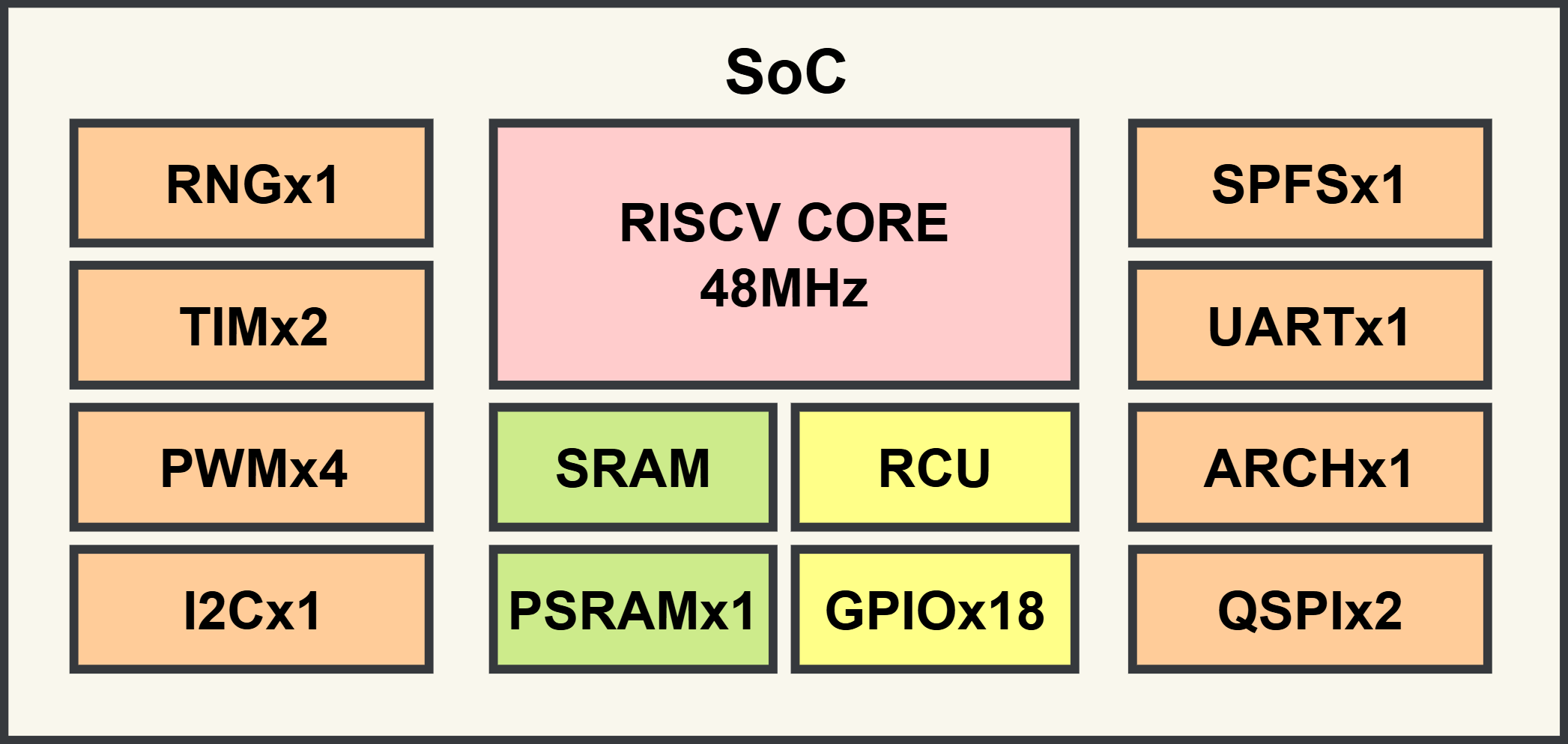
SoC Specification
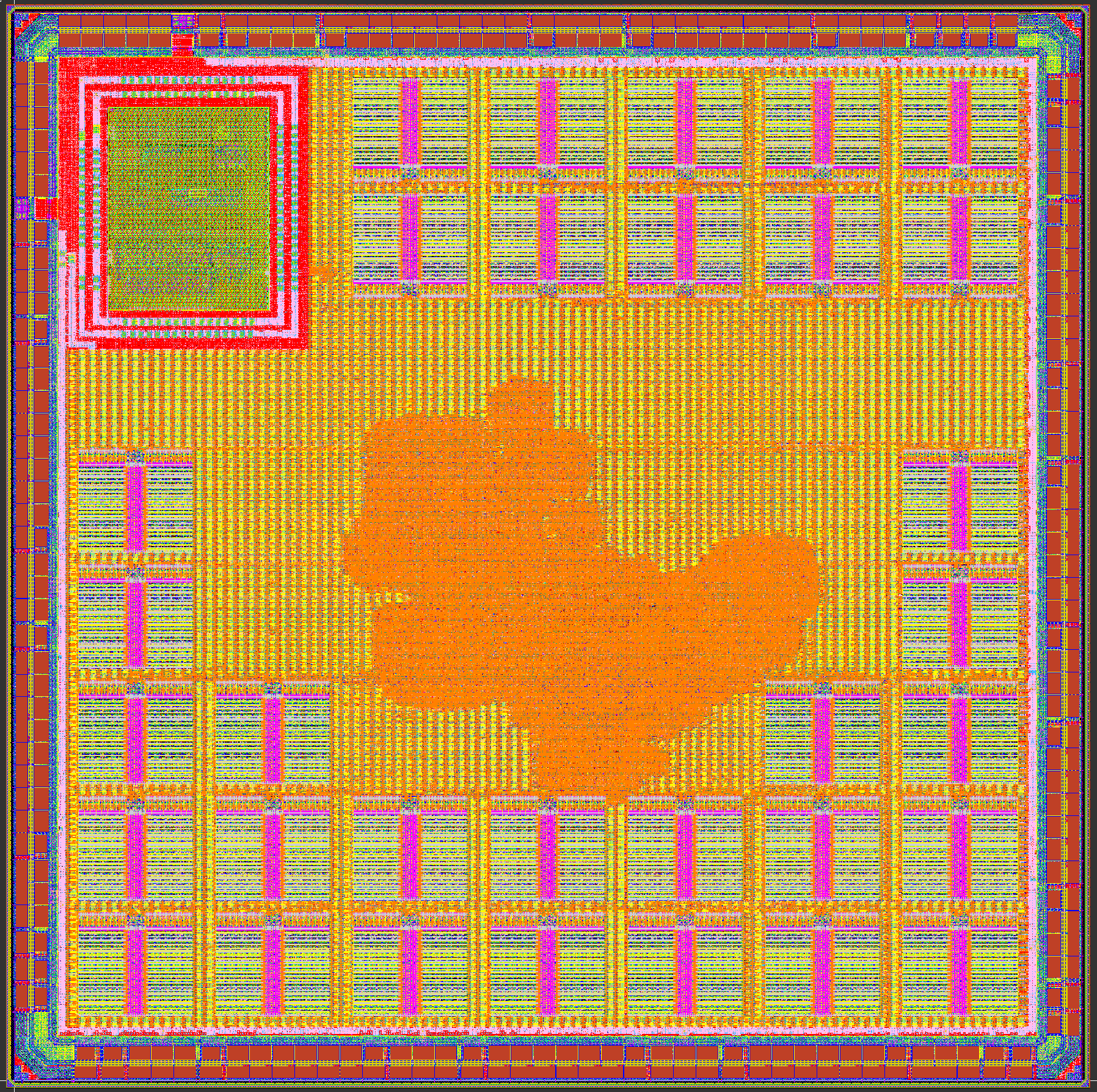
SoC Layout
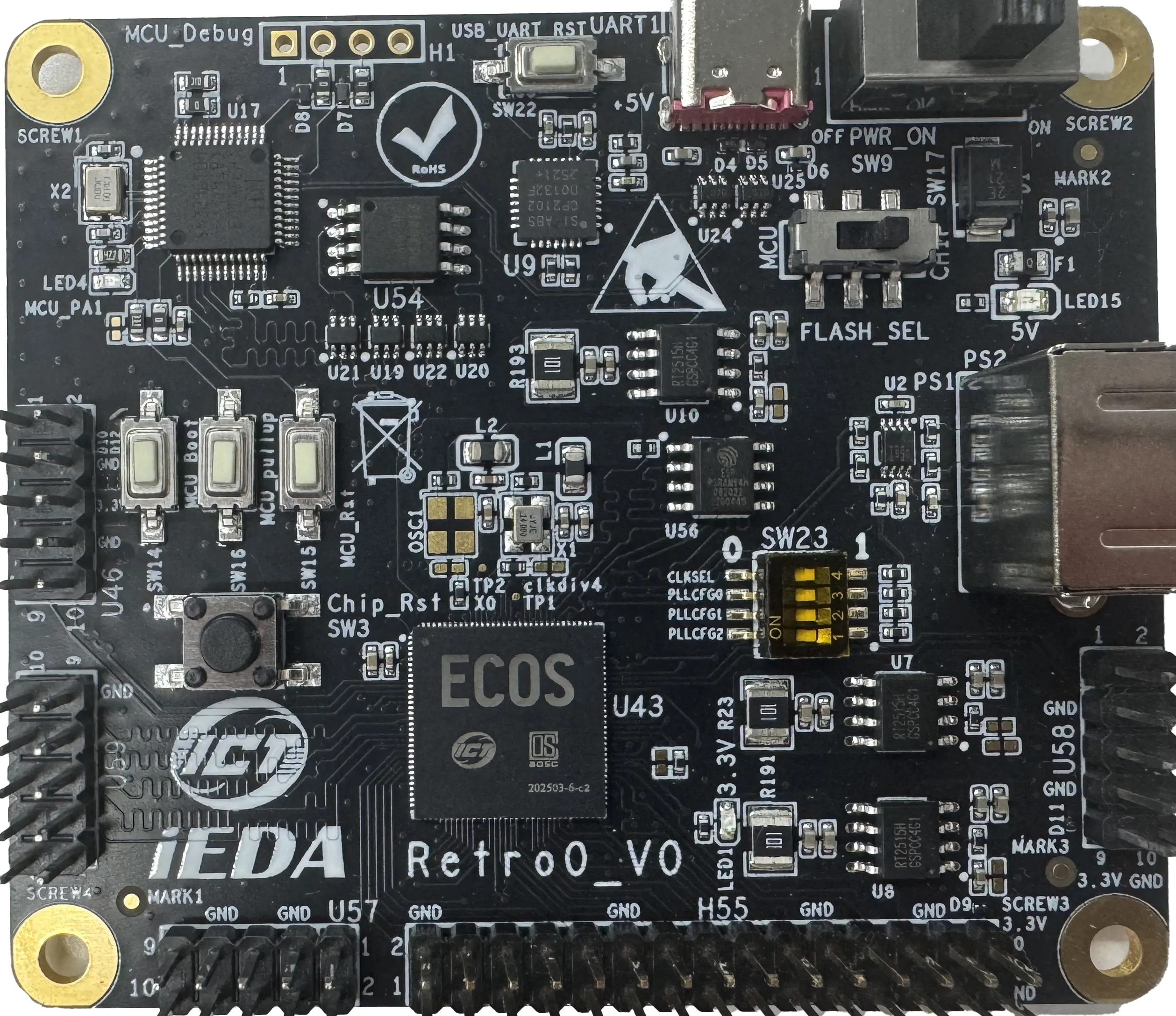
StarrySky C1 Board
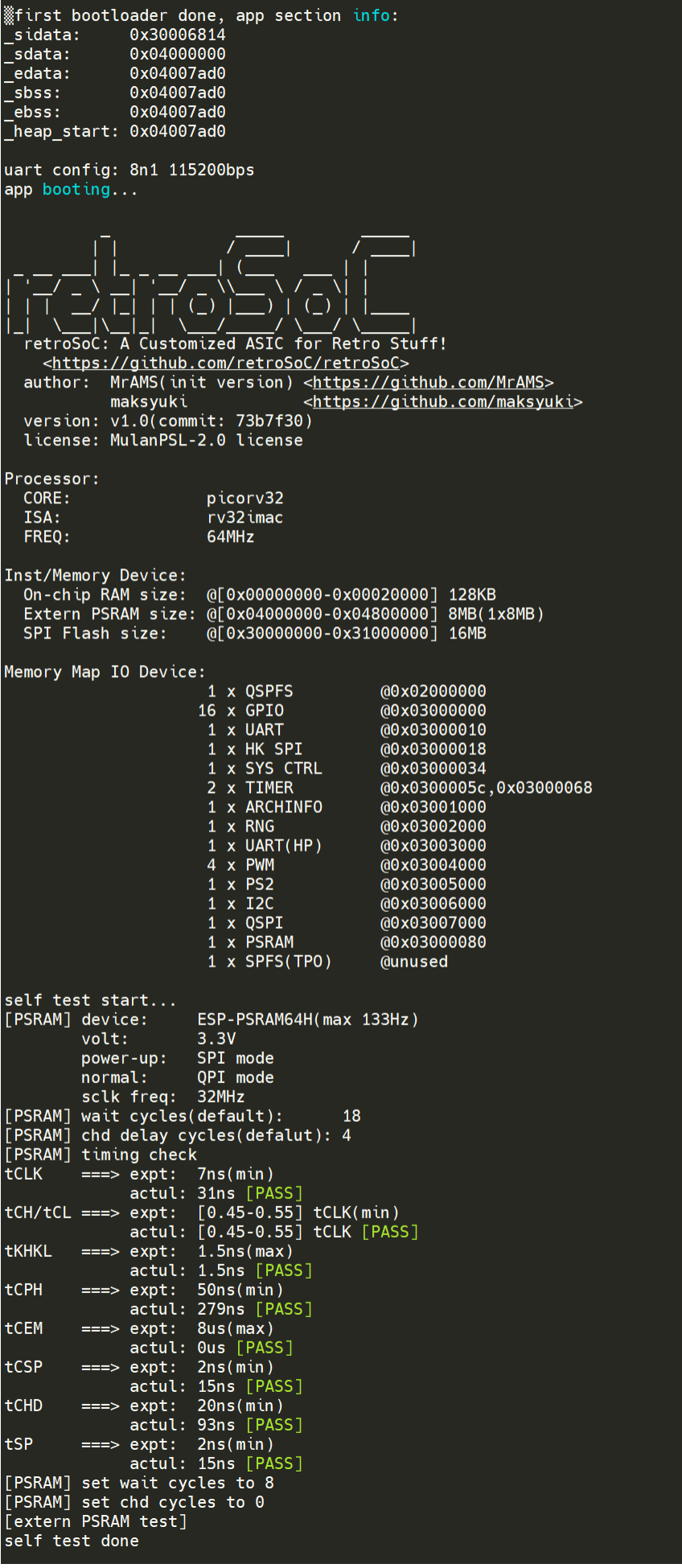
StarrySky C1 Board has passed the power-on test
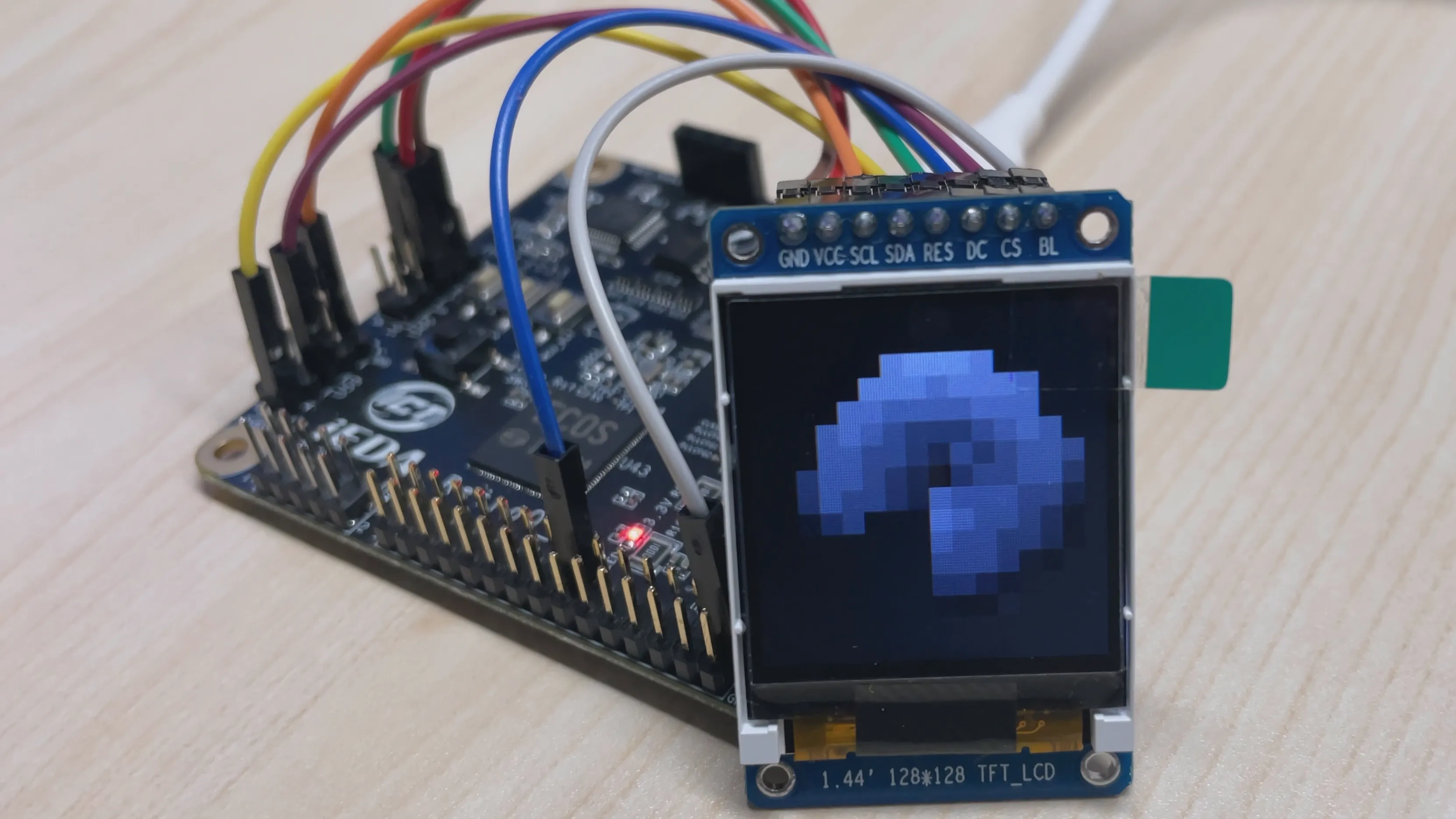
StarrySky C1 Board runs the donut program
Given the numerous inquiries from students, the ECOS Team plans to initiate the distribution, trial, and pilot sale of this chip.
Formal "One Student One Chip" trainees can apply to receive the chip for free based on their needs (in return for providing an unboxing and power-on video or article). Other enthusiasts can purchase it at an estimated price of around 100 RMB (proceeds will be used to support the "One Student One Chip" program and the iteration of open-source chip technology). [Interested students can join the WeChat group at the bottom].
The development board kit includes a PCB board integrated with the current chip, a USB cable for power supply and programming, common electronic development accessories (such as Dupont wires, breadboards, LEDs, switches, temperature and humidity sensors, LED screens, etc.), a software tool package (programming software, compilation toolchain, sample programs, etc.), and ECOS Team merchandise (e.g., stickers).
Due to the limited quantity of returned chips, the ECOS Team plans to initially release 50 sets of boards. We hope that all professionals interested in the open-source chip software/hardware ecosystem, those long-term active members of the embedded community, or individual enthusiasts passionate about designing embedded applications with open-source chips will participate in our pilot sales demand survey and the subsequent hands-on experience with this chip. Furthermore, we highly encourage everyone to record unboxing videos of the board, write detailed hands-on testing and embedded application development articles, or provide feedback on issues encountered during use and suggestions for improvement.
03 Team Goals and the Upcoming Tapeout Mode
The ECOS Team plans to complete the tapeout of an open-source SoC chip by the end of December this year using open-source IP, open-source SoC, open-source EDA, and the ICsprout 55nm open-source PDK. Different from the previous chip, this one will utilize the ICsprout 55nm open-source PDK and can be considered a fully open-source chip. Please stay tuned for updates.
The design flow for this chip includes: open-source IP and SoC, open-source simulation and verification tools (Verilator, Icarus Verilog), an open-source RTL-to-GDS toolchain (Yosys, iEDA, KLayout), and an open-source PDK (ICsprout 55nm). If the chip ultimately powers on successfully, open-source chip technology will take a crucial step forward.
In most people's perception, the cost of developing a chip is very high, involving tool expenses (EDA tools and IP), personnel costs, manufacturing costs (tapeout and packaging), etc., often amounting to millions. However, with the gradual maturation of the open-source chip design solution (open-source EDA + open-source IP + open-source PDK), the barrier and cost for designing a chip and performing a tapeout verification are significantly decreasing.
In fact, if not pursuing extreme PPA (Performance, Power, Area), with the help of the open-source solution, the total cost (design + tools + manufacturing) for a small-to-medium scale (million-gate level) chip (such as Rocket-chip) can be reduced to between 50,000 and 100,000 RMB. This means that if a student wants to design a development board equipped with their own chip (unit price 100 RMB/board), it would only take 1,000 people willing to purchase it to fully recoup the costs. For an even smaller chip (hundred-thousand-gate level), the cost could even drop to 10,000 RMB, requiring only 100 willing buyers. For example, you could team up with other students to design a processor SoC to be used as teaching equipment for next year's operating systems lab course. You could also integrate your own custom module to accelerate your algorithm for use in your robot, which wouldn't significantly increase the chip's cost.
04 Call for Free Tapeout Submissions
The December ICsprout 55nm shuttle run will carry the "One Student One Chip" trainee chips, as well as test tapeouts for open-source EDA and open-source IP. To support community members passionate about open-source hardware and to test the quality of the current open-source chip solution, we have decided to allocate a dedicated area on the shuttle to support free community tapeouts. You can develop your own SoC from scratch or based on existing open-source projects (such as Chipyard, PULP, etc.), submit it to the project team, and apply for a free tapeout.
The conditions and information for submissions are as follows:
- The tapeout deadline is expected to be in mid-December. Therefore, the code submission deadline is before October 31st.
- You can submit the RTL code for your SoC, and the ECOS Team will handle the backend design. Students interested in backend design are also welcome to attempt it themselves; we will provide the ICsprout 55nm open-source PDK data and technical support for open-source EDA tools.
- Students may also choose to submit only a processor core to be integrated into the ECOS Team's open-source SoC framework.
- The design scale is limited to under 100,000 instances (based on synthesis data using Yosys and the ICsprout 55nm open-source PDK).
- The SRAM and PLL within the open-source PDK are still under development. Please stay tuned for further announcements (expected to be available in October).
- The code submitted for the tapeout application can be self-developed or based on open-source projects. It must be free of intellectual property issues and be eligible for public open-sourcing.
- While exhaustive verification is not required, the design should pass basic tests, such as riscv-tests, booting RT-Thread or Linux, and running typical workloads and benchmarks.
To help everyone better understand this event, we have created a WeChat group and will organize a small-scale briefing/discussion session. Interested teachers and students are welcome to join online. The meeting details are as follows:
- Time: September 6, 2025, 15:00 - 16:00
- Tencent Meeting Link: https://meeting.tencent.com/dm/ZafjB30Hyt6L
- Tencent Meeting ID: 281-629-097

WeChat Group: Open Source Chip (Chip Trial and TapeOut Application)